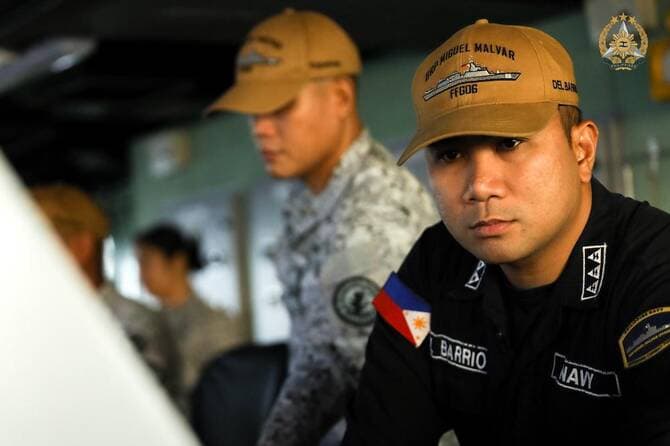
The Philippine and American navies concluded their seventh joint maritime exercise in contested South China Sea waters on Wednesday, marking another significant step in what has become one of the most consequential military partnerships in the Indo-Pacific region. The latest Maritime Cooperative Activity, conducted off the provinces of Occidental Mindoro and Zambales, represents far more than routine naval cooperation—it signals a dramatic realignment of regional power dynamics as Manila and Washington respond to China's increasingly assertive territorial claims. The exercise showcased the newly commissioned Philippine frigate Miguel Malvar, a 118-meter guided missile vessel that embodies the country's ambitious military modernization efforts. Built by South Korea's Hyundai Heavy Industries, the frigate represents a new generation of Philippine naval capabilities designed to defend the archipelago's vast maritime territory against increasingly sophisticated threats.
A Strategic Pivot Under Marcos
The intensification of Philippine-American military cooperation reflects the dramatic foreign policy shift orchestrated by President Ferdinand Marcos Jr. since taking office in 2022. Unlike his predecessor Rodrigo Duterte, who pursued a controversial rapprochement with Beijing while distancing Manila from Washington, Marcos has embraced a decidedly pro-American stance that has fundamentally altered the strategic landscape of Southeast Asia. This pivot represents more than mere policy adjustment—it constitutes a return to the Philippines' traditional role as America's most reliable Southeast Asian ally. The transformation has been particularly striking given the initial uncertainty surrounding Marcos's election, when many observers questioned whether the son of the former dictator would maintain his father's historically complex relationship with the United States. Under Marcos's leadership, military engagements between the treaty allies have reached unprecedented levels. The current series of maritime exercises builds upon expanded access agreements that allow American forces to operate from additional Philippine bases, creating a network of strategic positions that enhance both countries' ability to project power across the South China Sea.
The Miguel Malvar's Symbolic Importance
The inclusion of the Miguel Malvar in Wednesday's exercises carries profound symbolic significance beyond its operational capabilities. The frigate represents the Philippines' determination to build indigenous defense capabilities while strengthening partnerships with like-minded democracies. As one of two corvettes delivered under the country's military modernization program, the vessel demonstrates Manila's commitment to transforming its traditionally weak navy into a credible deterrent force.The ship's South Korean construction reflects the broader internationalization of Philippine defense procurement, as Manila seeks to diversify its military suppliers beyond traditional American sources. This approach allows the Philippines to access cutting-edge technology while maintaining strategic autonomy in its defense planning.The frigate's advanced missile systems and sophisticated radar capabilities provide the Philippine Navy with previously unavailable options for defending the country's extensive maritime territory. In a region where naval supremacy increasingly determines political influence, such capabilities represent crucial elements of national sovereignty.
China's Expanding Shadow
The need for enhanced Philippine-American cooperation has become increasingly urgent as China continues its systematic expansion throughout the South China Sea. Beijing's sweeping territorial claims, encompassing nearly the entire sea through its infamous nine-dash line, directly challenge the sovereignty of multiple Southeast Asian nations while threatening critical international shipping lanes. Chinese activities in the region have evolved from relatively passive presence operations to increasingly aggressive actions that include the construction of artificial islands, deployment of military equipment, and harassment of fishing vessels from neighboring countries. These escalatory moves have created a powder keg of tensions that could easily explode into broader conflict. For the Philippines specifically, China's activities pose direct threats to national sovereignty and economic interests. Filipino fishermen regularly report intimidation by Chinese coast guard vessels, while Philippine military patrols face increasingly aggressive responses from Chinese forces. The situation around Second Thomas Shoal, where the Philippines maintains a deliberately grounded naval vessel, has become a particular flashpoint for confrontation.
Regional Security Architecture
The Philippine-American maritime exercises occur within a broader context of evolving regional security arrangements designed to counter Chinese expansion. The strengthening of bilateral defense cooperation complements multilateral initiatives including the Quadrilateral Security Dialogue, the AUKUS partnership, and enhanced cooperation among ASEAN nations concerned about Chinese assertiveness. This network of overlapping security relationships represents a fundamental shift from the post-Cold War period, when economic integration took precedence over security concerns. The recognition that China's rise poses potential threats to the existing international order has prompted democratic nations to rebuild and strengthen military partnerships that had been allowed to atrophy. The exercises also demonstrate the practical implementation of America's Indo-Pacific strategy, which prioritizes strengthening alliances and partnerships to maintain regional stability. For Washington, the Philippines represents a crucial anchor in the island chain strategy designed to contain potential Chinese expansion beyond the first island chain.
Economic and Strategic Stakes
The South China Sea's importance extends far beyond military considerations to encompass crucial economic interests that affect global commerce. Approximately one-third of global shipping passes through these waters, including massive volumes of energy supplies and manufactured goods essential to the international economy. Any disruption to these shipping lanes would have catastrophic global consequences. For the Philippines, control over surrounding waters directly impacts access to potentially vast underwater energy reserves and rich fishing grounds that support millions of livelihoods. The country's exclusive economic zone includes substantial portions of the South China Sea, making territorial disputes existential questions of national economic viability. The strategic location of the Philippine archipelago also provides unique geographical advantages for monitoring and potentially controlling access to the South China Sea. This positioning makes the Philippines an invaluable partner for any nation seeking to maintain freedom of navigation through these critical waters.
Future Implications
The success of the latest maritime exercises suggests that Philippine-American cooperation will continue expanding regardless of potential changes in either country's political leadership. The institutional momentum behind this partnership reflects shared strategic interests that transcend partisan political considerations. However, significant challenges remain in translating tactical cooperation into broader strategic deterrence. China's overwhelming numerical advantages in naval vessels and maritime law enforcement capabilities mean that Philippine-American exercises, while symbolically important, cannot alone alter the fundamental balance of power in the region. The true test of this partnership will come if tensions escalate into actual confrontation. The mutual defense treaty between Manila and Washington theoretically obligates American military intervention in case of armed attack against Philippine forces, but the practical implementation of such commitments remains untested in the contemporary environment. As the seventh iteration of these joint exercises demonstrates, both nations remain committed to strengthening their cooperation in the face of growing regional challenges. Whether this partnership can successfully deter further Chinese expansion while avoiding unwanted escalation will likely determine the future stability of one of the world's most strategically important maritime regions.